top of page
Regional Timelines of Colonial Violence
31 documented events - spanning 1492 - 2024

700
Long before European colonialism, Arab and Persian traders operated extensive slave routes from East Africa across the Indian Ocean — a trade that European powers later expanded dramatically. From approximately 650 CE onward, enslaved Africans were transported from the Swahili Coast (present-day Tanzania, Kenya, Mozambique) through Zanzibar, and onward to the Arabian Peninsula, Persia, India, and as far as Southeast Asia and China. The island of Zanzibar became the world's largest slave market by the 19th century, with an estimated 50,000 enslaved people passing through annually. The Omani Sultanate, which controlled Zanzibar from 1698, made the slave trade the economic backbone of its empire. When Britain finally signed an anti-slave-trade treaty with Zanzibar's Sultan Barghash in 1873 under diplomatic pressure, the slave market was formally closed — but illegal trade continued for decades. Historians estimate between 2 million and 17 million enslaved Africans were sold through Indian Ocean routes over 1,200 years. The Portuguese, who colonized the East African coast from the 15th century, both participated in and disrupted existing Arab slave routes, eventually redirecting enslaved Africans toward Brazil. Unlike the transatlantic trade, the Indian Ocean slave trade has received comparatively little scholarly or public attention.
2–17 million enslaved over 1,200 years
Arab Sultanates / Portugal / Britain (via EIC)
East Africa / Zanzibar / Arabian Peninsula
The Indian Ocean and East African Slave Trade
1619

Between 1562 and 1807, Britain transported approximately 3.1 million enslaved Africans across the Atlantic — around 24% of the entire transatlantic slave trade. An estimated 1.8 million died during the Middle Passage alone. The trade generated the capital that funded Britain's Industrial Revolution. Cities like Bristol, Liverpool, and Glasgow were built on slave trade profits. When Britain abolished slavery in 1833, the government took out a £20 million loan (equivalent to approximately £17 billion today) to compensate 46,000 slaveholders. That loan was only fully repaid in 2015 — meaning British taxpayers were paying off slaveholder compensation until 2015. The enslaved people received nothing.
1.8 million died in transit alone
Britain (via EIC)
Multiple
British Transatlantic Slave Trade
1687

Wikimedia Commons — Elihu Yale (far left), whose wealth was built on enslaved Indian labour
Hundreds enslaved and transported to St. Helena
Britain / East India Company
India (Madras / Fort St. George)
Elihu Yale: Yale University's Founder Made His Fortune in the Indian Slave Trade
Elihu Yale (1649–1721), the man whose donations gave Yale University its name, made his fortune as Governor of Fort St. George (Madras) for the British East India Company from 1687 to 1692. Yale was a prolific slave trader. Under his tenure, the East India Company shipped enslaved Indian men, women, and children — many of them debtors, prisoners, or people kidnapped on spurious charges — to the island of St. Helena in the South Atlantic, where they laboured on British plantations. An 1687 Company order, signed during Yale's governorship, directed that '10 slaves be sent to St. Helena on every ship'. Yale was later dismissed for corruption and private trading, but had already accumulated enormous wealth through his illicit trade. In 1718, he donated £562 worth of goods, books, and a portrait to the Collegiate School of Connecticut, which renamed itself Yale College in his honour. Modern scholars, including Yale's own historians, have confirmed Yale's direct involvement in enslaving hundreds of Indians. The university has acknowledged this history but has not changed its name.
1757

The Battle of Plassey (June 23, 1757) was the pivotal moment the British East India Company seized control of Bengal — India's richest province — through military force and betrayal. EIC commander Robert Clive colluded with conspirators to defeat Nawab Siraj ud-Daulah. What followed was the systematic looting of Bengal's treasury. Within a decade, the Company had extracted £2–3 million annually from Bengal alone. Clive returned to Britain as one of the richest men in England. Historians regard Plassey as the founding act of the British Empire in India.
Britain / East India Company
India
Battle of Plassey — The East India Company Takes India
1765
_-_Shipping_off_Madras_-_BHC1890_-_Royal_Museums_Greenwich.jpg)
Economist Utsa Patnaik's 2018 calculation, published by Columbia University Press, estimates Britain extracted the equivalent of $45 trillion from India between 1765 and 1938. The mechanism: India was forced to export goods to Britain and the world, but payment was not made in gold or silver — instead credits were issued in London that were used to pay for British government expenditure including wars and imperial administration. India effectively financed its own occupation. This drain went alongside deliberate deindustrialization: India's share of global manufacturing fell from 25% in 1750 to under 2% by 1900. Meanwhile, Britain's Industrial Revolution was funded in part by capital extracted from Indian trade.
Britain / East India Company
India
The Drain of Wealth — $45 Trillion Extracted from India
1793

Before British rule, India produced roughly 25% of global GDP and was the world's largest exporter of textiles — particularly fine Dhaka muslin, so fine it was called 'woven air'. The East India Company systematically destroyed Indian textile manufacturing through punitive tariffs: Indian cloth faced 70–80% import duties in Britain, while British machine-made cloth entered India virtually tariff-free. Weavers were impoverished en masse. According to historian Shashi Tharoor, the town of Dacca (now Dhaka) saw its population collapse from 150,000 to 30,000 as the industry collapsed. By 1947, India's share of global GDP had fallen to just 4%.
Britain / East India Company
India
Destruction of India's Textile Industry
1803

The Inland Customs Line, known as the Great Hedge of India, was one of the strangest and least-known instruments of British colonial control. A vast barrier stretching approximately 3,700 km (2,300 miles) across the Indian subcontinent — from the Himalayas in the north to Orissa in the south and east — it was built and maintained by the British East India Company and later the British Crown to enforce a punishing salt tax. At its height in the 1870s, the hedge was up to 12 feet high, 14 feet thick, and so dense it could not be penetrated. It was patrolled by 14,000 armed officers. The hedge divided India into two tax zones: people in the interior paid 4–6 times more for salt than those near the coast. Salt was not a luxury — it was a daily dietary necessity, used in food preservation and especially vital for agricultural communities. The tax represented as much as 10% of the British colonial government's total Indian revenue. The salt barrier caused mass malnutrition, dietary disease, and poverty among India's poorest communities. It was exposed to the world only in 2001 by historian Roy Moxham, who traced its route on foot across modern India. The Hedge's legacy is most remembered through Mahatma Gandhi's 1930 Dandi Salt March — a deliberate act of civil defiance against the same colonial salt taxation system that the Hedge had enforced.
Britain / East India Company
India
The Great Hedge of India — A 4,000 km Salt Barrier
1830

The Indian Removal Act of 1830 authorized the forced displacement of the Five Civilized Tribes from their ancestral lands in the southeastern United States. The Cherokee, Creek, Seminole, Chickasaw, and Choctaw nations — many of whom had adopted American-style governance, Christianity, and plantation farming — were marched at gunpoint westward to 'Indian Territory' in present-day Oklahoma. An estimated 4,000–15,000 Native Americans died of cold, hunger, and disease on the march. The act was signed by President Andrew Jackson despite the Supreme Court ruling in Worcester v. Georgia (1832) that the Cherokee had sovereign rights. Jackson reportedly responded: 'Justice Marshall has made his ruling; now let him enforce it.'
4,000–15,000 deaths
USA Governement
United States
Trail of Tears - US Indian Removal Act
1839
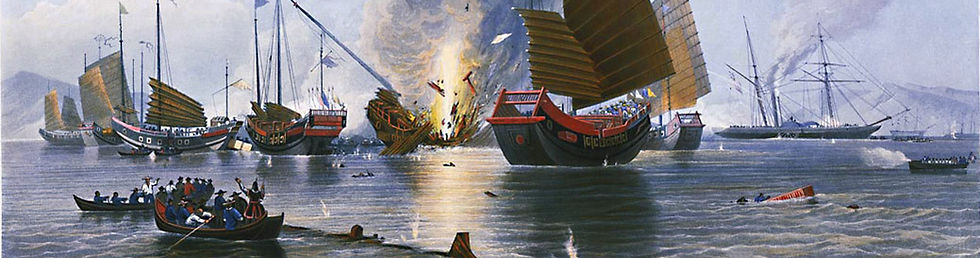.jpg)
To correct a trade deficit with China, the British East India Company began mass-producing opium in Bengal and smuggling it into China against explicit Chinese law. When Chinese authorities confiscated and destroyed 20,000 chests of British opium in 1839, Britain launched the First Opium War (1839–42). China was forced to cede Hong Kong, pay reparations, and open five 'treaty ports'. The Second Opium War (1856–60) saw Britain and France burn the Summer Palace in Beijing and force further humiliations. By 1900, approximately 13 million Chinese people were addicted to opium — a deliberate policy of economic subjugation through narcotics, orchestrated from India.
20,000+ in military action; millions addicted deaths
Britain
Indo-China
Opium Wars - Britain forced drugs on china via India
1857

The 1857 Indian Rebellion (called a 'mutiny' by the British) began among East India Company sepoys (Indian soldiers) over religious desecration of cartridges, but quickly spread into a broader uprising against colonial rule. British reprisals were savage: suspected rebels were tied to cannon barrels and blown apart ('blown from guns'), thousands were hanged without trial, and entire villages were burned. Delhi was devastated and looted. The uprising ended Company rule — transferring India directly to the British Crown — but also intensified racist British attitudes that would shape colonial policy for the next 90 years.
Hundreds of thousands deaths
Britain / East India Company
India
Indian Rebellion of 1857 — Britain's Reprisals
1876

The Great Famine of 1876–1879 killed between 6 and 10 million people in south and western India during Viceroy Lytton's administration. Rather than suspend exports, the colonial government — guided by free-market ideology — continued exporting grain from famine-affected regions to Britain. Famine relief camps imposed brutal caloric restrictions: inmates received fewer calories than Buchenwald concentration camp prisoners in 1944 (as calculated by Mike Davis). Viceroy Lytton simultaneously hosted an extravagant Delhi Durbar banquet for 68,000 guests as millions starved.
6–10 Million Deaths
Britain / East India Company
India
Great Famine of 1876–79
1885

King Leopold II of Belgium personally owned the Congo Free State (1885–1908) as a private colony, not as a Belgian state territory. To enforce rubber quotas, his Force Publique soldiers severed the hands of Congolese workers — and their families, including children — as proof of bullets used. Baskets of severed hands were presented to Belgian officers as receipts. Population estimates suggest between 10 and 13 million Congolese died from violence, famine, and disease during Leopold's reign. British journalist E.D. Morel and photographer Alice Seeley Harris documented and exposed the atrocities to the world. The hands of children are among the most documented evidence of Leopold's regime.
10-13 Million Deaths
Belgium
Democratic Republic of Congo
Congo Free State — Leopold II's Private Torture Colony
1893
.jpg)
On January 17, 1893, US Marines landed in Honolulu to support a group of American sugar plantation owners who overthrew Queen Liliuokalani, the Hawaiian head of state. The US Minister to Hawaii, John Stevens, had colluded with the coup plotters. A formal request to annex Hawaii was initially rejected by President Grover Cleveland, who called the coup 'an act of war'. Five years later, in 1898, Congress annexed Hawaii anyway during the Spanish-American War frenzy. In 1993, the US Congress formally apologized for the overthrow, acknowledging it was illegal. Native Hawaiians — now a minority in their own land — continue to advocate for sovereignty. The annexation was driven entirely by US commercial and strategic interests.
USA Government
Hawai
US Annexation of Hawaii — Illegal Overthrow of a Sovereign Nation
1897

Wikimedia Commons - Ota Benga at the Bronx Zoo, with Polly the chimpanzee Verner brought from the Congo
Between 1870 and 1958, European countries — including Belgium, Germany, France, Spain, Britain, Switzerland, Italy, and the United States — displayed living African, Asian, and Indigenous people in public exhibitions known as 'human zoos' or 'ethnographic expositions'. King Leopold II's Congo Free State provided many of the Congolese people exhibited at Belgian fairs. The 1897 Brussels International Exposition featured 267 Congolese people in a mock African village; seven died during the exhibition and were buried in Belgium. The 1906 Bronx Zoo in New York displayed Congolese man Ota Benga in a cage with an orangutan. French exhibitions ran until 1912; Belgium held its last 'human zoo' display at the 1958 Brussels World Fair, just two years before the Congo's independence. These exhibitions were used to justify colonial rule as 'civilizing savages' and reached audiences of hundreds of millions.
Belgium, France, Germany, USA
Belgium, Germany, France, USA
Human Zoos — Africans Displayed as Exhibits in Europe
1897

In January 1897, after a British trade delegation was attacked near Benin City (present-day Nigeria) — a journey undertaken without proper authorization — Britain launched the 'Punitive Expedition'. British forces burned Benin City to the ground and looted the Royal Palace, seizing over 3,000–5,000 brass plaques, ivory carvings, and sculptures — the Benin Bronzes — which dated to the 13th century. The objects were sold to pay expedition costs and distributed to museums. The British Museum acquired the largest share. An ancient and sophisticated African civilization was destroyed, its cultural memory scattered across 160 institutions in 20 countries. Nigeria has been requesting repatriation since the 1960s.
Nigeria
Britain
Benin Punitive Expedition — The Great Art Theft
Thousands in Benin City deaths
1897

After defeating Spain in 1898, the United States purchased the Philippines for $20 million and refused to grant independence, triggering the Philippine-American War (1899–1913). US soldiers employed systematic atrocities including the 'water cure' (an early form of waterboarding), burning of villages, and concentration camps. General Jacob Smith ordered troops to kill every Filipino over the age of ten on the island of Samar: 'I want no prisoners. I wish you to kill and burn; the more you kill and burn, the better you will please me.' An estimated 200,000–1 million Filipinos died — primarily from famine and disease caused by US scorched-earth tactics. US Senator Albert Beveridge defended the occupation: 'The Philippines are ours forever... We will not retreat from the mission of our race.'
USA
Philippines
US Conquest of the Philippines
200,000–1 million deaths
1900
.jpg)
During the Second Boer War (1899–1902), Britain created what many historians consider the first modern concentration camps to detain Boer civilians. Over 45,000 people died — 28,000 Boers (mostly children under 5) and at least 20,000 Black Africans held in entirely separate, worse-provisioned 'native camps'. Camp mortality rates reached 34% annually for Boer children. British journalist Emily Hobhouse toured the camps in 1901 and published devastating reports, triggering international outrage. The British press initially dismissed her reports as unpatriotic. General Kitchener burned 30,000 Boer farms as a scorched-earth policy.
45,000+ deaths
Britain
South Africa
Boer War Concentration Camps
1904

German colonial forces in present-day Namibia carried out the first genocide of the 20th century against the Herero and Nama peoples (1904–1908). General Lothar von Trotha issued the Vernichtungsbefehl (Extermination Order), explicitly stating: 'Within the German borders, every Herero, whether found armed or unarmed, with or without cattle, will be shot'. Survivors were driven into the Omaheke desert to die of thirst and starvation. Concentration camps were established where prisoners were used for forced labor and medical experiments — experiments later continued by Josef Mengele at Auschwitz. An estimated 80% of the Herero population and 50% of the Nama population were killed. Germany formally acknowledged the genocide in 2021, but paid only €1.1 billion — rejected by Herero and Nama leaders as inadequate.
65,000–80,000 deaths
Germany
Namibia
Herero and Namaqua Genocide
1910

CC0 - The successive breeding out of "colour" in the Aboriginal population, demonstrated here in A. O. Neville's "Australia's coloured minority" book
From approximately 1910 to 1970, Australian government policies authorized the forcible removal of Aboriginal and Torres Strait Islander children from their families. Between 10% and 33% of all Aboriginal children were taken. Children were placed in church missions or white households, forbidden from speaking their languages, and often subjected to abuse. Many were never allowed to return. The 1997 Bringing Them Home report confirmed these policies constituted genocide under international law. The Australian government issued a formal apology in 2008 under Prime Minister Kevin Rudd. No financial compensation has been paid to survivors.
Britain / Australia
Australia
Australia's Stolen Generations
1917

On November 2, 1917, British Foreign Secretary Arthur James Balfour wrote a letter to Walter Rothschild, a leader of the British Jewish community, declaring that 'His Majesty's Government view with favour the establishment in Palestine of a national home for the Jewish people'. This letter — 67 words — became the foundational document of modern Israel. At the time it was written, Palestine was inhabited by approximately 700,000 Arabs (90% of the population) and 56,000 Jews. Britain had no legal right to promise the land: Palestine was still part of the Ottoman Empire. Balfour himself was openly antisemitic and opposed Jewish immigration to Britain, but supported Zionism partly as a tool of imperial strategy. The letter contained a significant caveat — that 'nothing shall be done which may prejudice the civil and religious rights of existing non-Jewish communities in Palestine' — a condition that was entirely disregarded. The Balfour Declaration set in motion a chain of events that led directly to the 1948 Nakba, the displacement of over 750,000 Palestinians, and the ongoing occupation that continues today.
Britain
Palestine
The Balfour Declaration — Britain Promised Land It Did Not Own
1919

On April 13, 1919 — the Sikh festival of Vaisakhi — thousands of unarmed civilians gathered at Jallianwala Bagh, an enclosed public garden in Amritsar, Punjab. British Brigadier-General Reginald Dyer ordered his troops to block the only exit, then open fire without warning. Troops fired 1,650 rounds over approximately 10 minutes until ammunition was exhausted. The British government officially recorded 379 dead; Indian National Congress counted over 1,000. The narrowness of the well in the garden — still visible today — shows where hundreds attempted to escape by jumping in. Dyer returned to Britain to a hero's welcome and was gifted £26,000 by the Morning Post newspaper. The massacre radicalized a generation of Indians, including Bhagat Singh and a young Jawaharlal Nehru.
Britain
India
Jallianwala Bagh Massacre

1921
On May 31–June 1, 1921, white mobs attacked and burned Greenwood, a prosperous Black neighborhood in Tulsa, Oklahoma — known as 'Black Wall Street'. Over 35 blocks of homes, churches, schools, hospitals, and businesses were destroyed. At least 300 Black residents were killed and 10,000 left homeless. The massacre was the deadliest racial massacre in US history. Crucially, the Tulsa Police Department deputized white civilians who participated in the destruction, and the Oklahoma National Guard arrested Black survivors. Planes are reported to have fired on and dropped incendiary devices on the neighborhood. The massacre was covered up for decades; Oklahoma's official 2001 commission found the city and state bore direct responsibility. Survivors and descendants have never received reparations.
USA
USA
Tulsa Race Massacre — Greenwood Destroyed
1943
.jpg)
The Bengal Famine of 1943 killed between 2.1 and 3 million people. While drought and wartime disruption played a role, historian Madhusree Mukerjee conclusively shows Churchill's war cabinet actively diverted food supplies from Bengal to British troops in Europe and Australia, 'as a buffer stock'. Churchill rejected multiple urgent requests for emergency food aid from the Secretary of State for India and Viceroy Wavell. In a note to his War Cabinet, Churchill asked why Gandhi had not yet died. The famine was compounded by a government policy of 'denial policy' — destroying boats and rice stocks in Bengal to prevent Japanese use — which ruined local food distribution entirely. Journalist and famine survivor Bina Biswas recalled seeing rice loaded onto ships in Calcutta as bodies filled the streets. Churchill later blamed Indians for 'breeding like rabbits'.
2.1 - 3 Million Deaths
Britain
India
Bengal Famine — Churchill's Engineered Starvation

1945
In 1945, France introduced the CFA franc (Colonies Françaises d'Afrique — African French Colonies) as the currency for its African territories. After African independence in the 1960s, France negotiated agreements requiring 14 nations — Senegal, Mali, Burkina Faso, Niger, Guinea-Bissau, Ivory Coast, Benin, Togo, Cameroon, Chad, Central African Republic, Congo-Brazzaville, Gabon, and Equatorial Guinea — to keep using it. Until 2005, these nations were required to deposit 65% of their foreign reserves in the French Treasury (reduced to 50% until 2019). France retains de facto veto power over their monetary policy through the Central Bank of West African States. Economist Ndongo Samba Sylla estimates France extracts approximately €500 billion annually through this mechanism. When Burkina Faso, Mali and Niger's military governments announced plans to exit the CFA in 2023, France imposed sanctions. No former British colony has ever been required to continue using British currency after independence.
France
14 African Nations
The CFA Franc — France's Colonial Currency Still in Use
1947
.png)
The Radcliffe Line was drawn in just six weeks by Cyril Radcliffe, a British barrister who had never visited India. The line that divided British India into India and Pakistan was completed on August 12, 1947 — two days before independence — and kept secret until August 17. By then, millions were already in motion with no idea which side of the border their homes and families would land on. The resulting communal massacres killed between 200,000 and 2 million people. Between 14 and 18 million people were displaced — the largest forced migration in human history. Historians argue the deliberate speed of partition was a British abdication of responsibility, not an orderly handover.
200,000 - 2 Million Deaths
Britain
India Pakistan
Partition of India — 14 Million Displaced
1947
.jpg)
The Radcliffe Line is the boundary demarcation between India and Pakistan drawn by Sir Cyril Radcliffe — a British barrister who had never visited India. Appointed just five weeks before independence, Radcliffe was given inadequate maps, incomplete census data, and impossible competing demands from Muslim League and Congress negotiators. His line split Punjab in the west and Bengal in the east, severing railways, irrigation canals, rivers, temples, mosques, and villages in two. In Punjab, the line separated Lahore (given to Pakistan) and Amritsar (given to India) — two cities whose economies were deeply intertwined. The line was withheld from public knowledge until August 17, 1947, two days after independence was declared, meaning millions of people in the wrong country had already begun their forced journeys. Between 14 and 18 million people were displaced — the largest forced migration in recorded history. Up to 2 million people were killed in communal massacres in Punjab alone. The Radcliffe Line remains one of the most consequential and catastrophic examples of rushed decolonization. Radcliffe burned all his notes and papers and left India on the day the line was published, never returning. He reportedly said he was 'glad to be leaving so quickly'.
200,000 - 2 Million Deaths
Britain
India Pakistan
The Radcliffe Line — A Nation Divided in Six Weeks
1948

The Radcliffe Line is the boundary demarcation between India and Pakistan drawn by Sir Cyril Radcliffe — a British barrister who had never visited India. Appointed just five weeks before independence, Radcliffe was given inadequate maps, incomplete census data, and impossible competing demands from Muslim League and Congress negotiators. His line split Punjab in the west and Bengal in the east, severing railways, irrigation canals, rivers, temples, mosques, and villages in two. In Punjab, the line separated Lahore (given to Pakistan) and Amritsar (given to India) — two cities whose economies were deeply intertwined. The line was withheld from public knowledge until August 17, 1947, two days after independence was declared, meaning millions of people in the wrong country had already begun their forced journeys. Between 14 and 18 million people were displaced — the largest forced migration in recorded history. Up to 2 million people were killed in communal massacres in Punjab alone. The Radcliffe Line remains one of the most consequential and catastrophic examples of rushed decolonization. Radcliffe burned all his notes and papers and left India on the day the line was published, never returning. He reportedly said he was 'glad to be leaving so quickly'.
15,000 Deaths
Britain (mandate) / Zionist paramilitary forces
Israel Palestine
The Nakba — 750,000 Palestinians Expelled from Their Land
1952

During the Mau Mau uprising (1952–1960), the British colonial administration detained over 150,000 Kenyans in a network of concentration camps known as the 'Pipeline'. Declassified Foreign Office documents (the 'Hanslope Disclosure', released after a 2011 survivors' lawsuit) confirmed systematic torture including castration with pliers, electric shocks, sexual violence, and burning alive. The documents also showed the British government knowingly destroyed evidence of its own crimes. In 2013, the British government paid £19.9 million in compensation to 5,228 surviving torture victims — while refusing to acknowledge state responsibility. Historian Caroline Elkins estimates between 30,000 and 300,000 Kenyans died in detention.
30,000 - 300,000 Deaths
Britain
Kenya
British Concentration Camps in Kenya
1960

During the Cold War, the United States provided consistent military, economic, and diplomatic support to white minority regimes and authoritarian leaders across Africa, prioritizing anti-communism over human rights. The CIA was involved in the assassination of Congolese independence leader Patrice Lumumba in 1961. The US continued arms exports and intelligence sharing with apartheid South Africa until 1986, when Congress overrode President Reagan's veto to pass the Comprehensive Anti-Apartheid Act. Reagan had called the ANC 'a terrorist organization'. The US also backed dictators including Mobutu Sese Seko (Congo), Jonas Savimbi (Angola), and Mohamed Siad Barre (Somalia), whose regimes killed or displaced millions.
USA
Multiple African Nations
US Support for African Dictators & Apartheid
1967

100,000+ Deaths
Israel
Palestine (West Bank & Gaza)
Israeli Military Occupation of the West Bank and Gaza (1967–present)
In June 1967, Israel occupied the West Bank, Gaza Strip, Sinai Peninsula, and Golan Heights following the Six-Day War. Sinai was later returned to Egypt. The West Bank and Gaza have remained under Israeli military occupation for over 57 years — the longest military occupation in modern history. In the West Bank, Israel has constructed over 700,000 illegal settlements in violation of the Fourth Geneva Convention, which prohibits an occupying power from transferring its civilian population into occupied territory. The International Court of Justice ruled in July 2024 that Israel's occupation of Palestinian territory is unlawful and must end. Palestinians in the West Bank live under military law while Israeli settlers living next to them are governed by civilian law — a system that Human Rights Watch, Amnesty International, and the Israeli human rights organization B'Tselem have each characterized as apartheid. Movement is controlled through 700+ checkpoints and a 700 km separation barrier that annexes Palestinian land. Gaza has been blockaded since 2007, described by former British PM David Cameron as 'an open-air prison'.
1967

45,000+ killed (2023–2024)
Israel (backed by US/UK arms)
Palestine & Gaza
Gaza Bombardment — International Court Rules Plausible Genocide (2023–present)
Following Hamas's October 7, 2023 attack on Israel — which killed approximately 1,200 Israelis — Israel launched a military campaign in Gaza that has resulted in one of the most intense bombardments of a civilian population in modern history. By late 2024, over 45,000 Palestinians had been killed, including more than 17,000 children — numbers verified by Gaza's Ministry of Health and corroborated by international agencies. Over 1.9 million people (85% of Gaza's population) were displaced. The UN declared Gaza 'uninhabitable'. Israel systematically destroyed hospitals, schools, universities, mosques, and UN refugee shelters. On January 26, 2024, the International Court of Justice (ICJ) ruled in South Africa v. Israel that it was 'plausible' that Israel was committing genocide under the 1948 Genocide Convention, and issued six provisional measures. Israel has not complied. The US, UK, and Germany continued to supply weapons and diplomatic cover throughout. UN Special Rapporteur Francesca Albanese concluded in March 2024 that 'there are reasonable grounds to believe that the threshold indicating Israel's commission of genocide is met'. The events of 2023–24 must be understood in the context of 75 years of dispossession, occupation, and blockade.

bottom of page